January 2012
-
For those of you who missed the announcement (or just the event itself), here's a recording of last week's very interesting Singularity University webcast featuring Carl Bass: If you're interested in viewing others in the "Which Way Next?" series (there are two posted, at the time of writing), please visit the WWN archive.
-
photo credit: rednivaram via photopin cc Most readers of this blog won't have realised (mainly because I queued up last week's blog posts in advance of my trip) that I was in India for the whole of last week. Not that I'm under any illusions that there are people out there wondering where I am, but I did want to talk a little about my trip – and my connection to India – as the topic of today's post. I've been visiting Bangalore since I was a child: my parents met when my father was working there as an ex-pat…
-
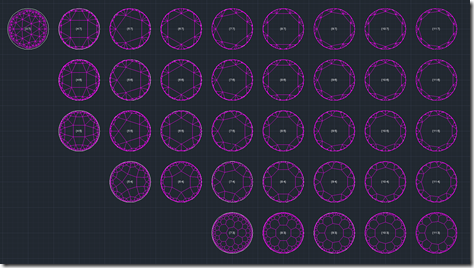
To follow on from this recent topic, today's post looks at a simple script to generate various hyperbolic tessellations, laying them out in an order that makes some sense of the progressive nature of the patterns that can be generated using the HT command. Here's an AutoCAD script (which can be saved as an .scr and executed using the SCRIPT command) to generate all the valid {n k} patterns where n <= 11 and k <= 7 (n being the number of sides in each polygon, k is the number of polygons that meet at each vertex). The application module…
-
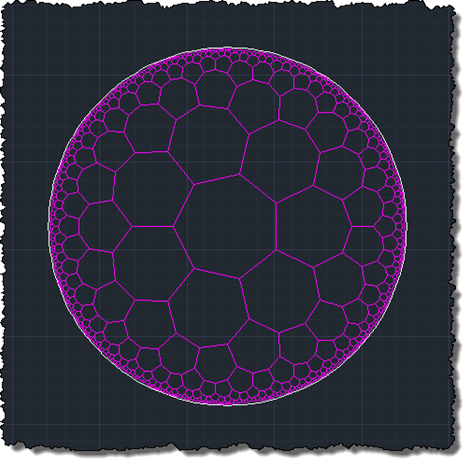
Following on from the post introducing this series, and the last post focused on generating simple hyperbolic geometry, this post looks at generating hyperbolic tessellations inside AutoCAD. Having "borrowed" some C++ code, last time, today we're going to borrow some Java. That's one of the great things about the C family of languages: the relatively small amount of work that's often needed to move code between environments. 🙂 This article, written by David E. Joyce, Professor of Mathematics and Computer Science at Clark University, has provided the best information I could find with regards to a hyperbolic tiling algorithm (especially…
-
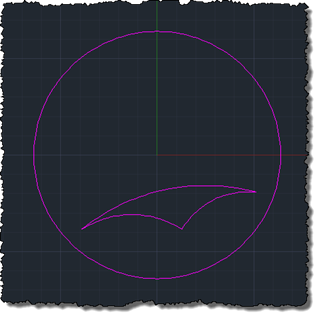
As mentioned in the last post, today's post looks at how to draw hyperbolic geometry using the Poincaré disk model inside AutoCAD. This is an interesting exercise, but probably won't ultimately help us with the hyperbolic tessellations we're aiming to create: it's interesting as it will end up with us having a mechanism for mapping hyperbolic geometry onto an arbitrary circle inside AutoCAD, but as we're probably going to end up creating straight-lined segments for the polygons we use to create our pattern, it's mostly an exercise (and will probably be largely irrelevant to our end result). The tough part…
-
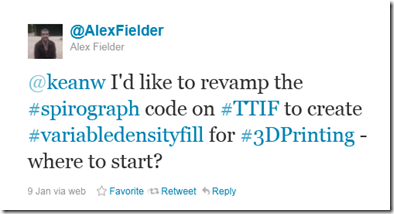
A regular follower of this blog and someone I now consider a friend through our online interactions, Alex Fielder, recently laid down the gauntlet for the topic of the coming series of posts. He started with Twitter… … and then moved on to The Swamp (which he thankfully also brought to my attention using Twitter). Alex has become interested in an area that I can see becoming increasingly relevant: given the fact that 3D printing is an additive, rather than subtractive or mold-based, process, shouldn't we take advantage of this fact to optimise the composition of an object's internal structure?…
-
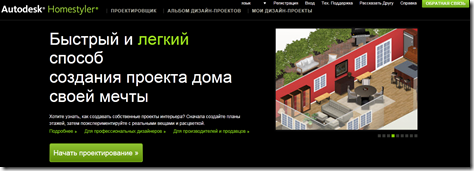
I mentioned some time ago that our Localization Services (LS) team was embarking on a community-based translation of Homestyler into Russian. The fruits of this labour are now ready for testing: the various translation projects, for the application, for its content and for supporting web-pages are now 100% complete. But that's not to say things haven't been missed or mis-translated, so we would love to get feedback from Russian speakers on the quality of the work performed. The below information has been provided by our LS team for people who are interested in taking Russian Homestyler for a spin (and…
-
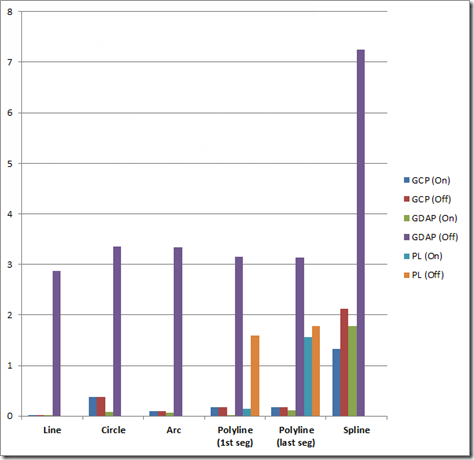
A couple of recent posts have covered different ways of checking whether a point is on a curve. This post looks at a rudimentary way of profiling the relative performance of these various methods, in order to determine the best approach to use, in general. There are various performance profiling technologies available on the market, but given the specificity of the cases we wanted to test and compare, I rolled my own very simple approach. Nothing at all earth-shattering, just a helper function that will call one of our methods (passed in as a delegate with a specific signature) a…
-

I'm delighted to be announcing that Jim Quanci, Director of the Autodesk Developer Network, has started a blog on partnering with large companies such as Autodesk: Dances with Elephants. I know Jim has been considering writing a blog for some time, and I'm really happy he's managed to find the time in his busy schedule to get this one going. I've worked with Jim pretty much since I started at Autodesk, and have reported directly to him for the last 6.5 years (although that will change in a few short weeks). I'm definitely going to miss being part of his…
-
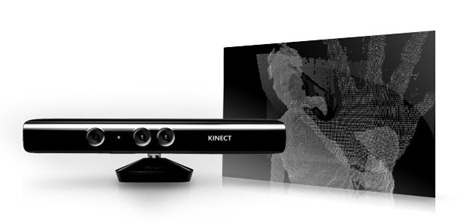
As expected, Microsoft has announced at CES 2012 that Kinect for Windows devices will become available from February 1st, priced at $249. Those of you who attended my Kinect class at AU 2011 will probably remember me speculating about the eventual cost for this device, and that it would preferable for Microsoft to recoup more of their technology investment from the physical devices than they had from the equivalent devices for Xbox 360, and therefore avoid developers having to pay Microsoft directly for the use of their SDK. I think I suggested it'd be fine to pay $200 or more…